How We Built a Skin AI That Evaluates with Precision
Dermatologists grade skin in steps, yet INSKINVIEW scores run 0 to 100. This is how a model trained on grades learns to read a fine-grained scale.

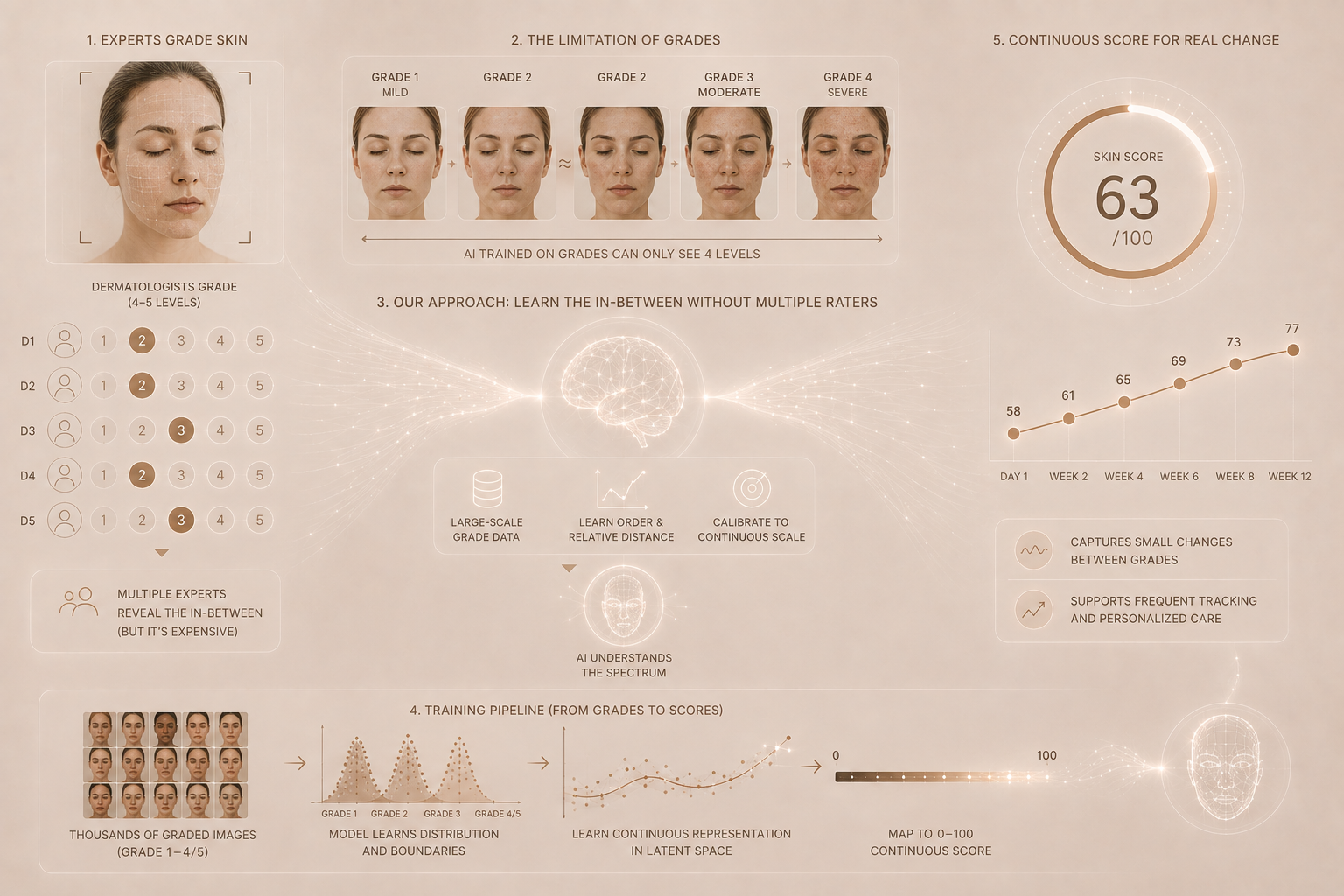
INSKINVIEW shows your skin across six axes, each scored from 0 to 100. But where does that score come from? That's today's story — and behind it sits a dilemma that anyone building skin-assessment AI eventually runs into.
Experts evaluate skin in grades
Ground truth for skin assessment is usually built as grades: mild, moderate, severe — four or five steps.
The reason is simple: people can't rate on a continuous scale. Ask a dermatologist "how many points out of 100 is this wrinkle?" and it's nearly impossible to answer; no human eye separates a 63 from a 67. But ask "which of four grades?" and they can. It's why the assessment tools I wrote about earlier, like IGA, are all grade-based.
But grades can't show change
The problem is that a model trained on grades knows only grades. Teach it four steps, and it sees the world in four steps.
That creates an awkward situation. Your skin may be improving little by little with steady care, but as long as it moves within grade 2, the model keeps answering "grade 2." I've written that measuring often is what reveals the trend; but if the model can't resolve subtle change, frequent measurement loses its point.
Nor does force-converting grades into scores solve it. Mechanically calling grade 2 a "50" doesn't mean the model knows the difference between a 48 and a 53.
Pooling several experts works — except for the cost
There's one known remedy, and it's the one I used in the atopic dermatitis study I mentioned earlier: have several specialists rate the same photo. I collected five raters at the time.
Five raters don't return one identical grade — and that disagreement is exactly the information. A photo all five call grade 2 and a photo split between 2 and 3 are in different states. The subtle territory between grades emerges through the distribution. Trained this way, a model learns to read between the grades.
But the limit is obvious: cost. Getting multiple specialist ratings for every photo becomes untenable as the data grows.
Reading between grades, without the panel
So we found another way: a model that understands grade-based ground truth as a fine-grained 0–100 score, without pooling multiple raters. The specifics are our own know-how, so I won't lay them all out here — but the direction is clear.
This keeps two things at once. The standard remains the dermatologist's judgment, while the model learns changes finer than any single grade.
That's why InskinView's score runs 0 to 100 rather than in grades. To show the difference between a 61 today and a 65 next month, the model has to be able to read that interval. I've said that measuring often reveals the trend. But before that, we needed a vessel fine enough to hold one.