Drawing the Timeline of Skin Aging from Data
Wrinkles, pigmentation, and sagging don't age at the same speed. This is the timeline of skin aging drawn from thousands of people — and how it differs between men and women.

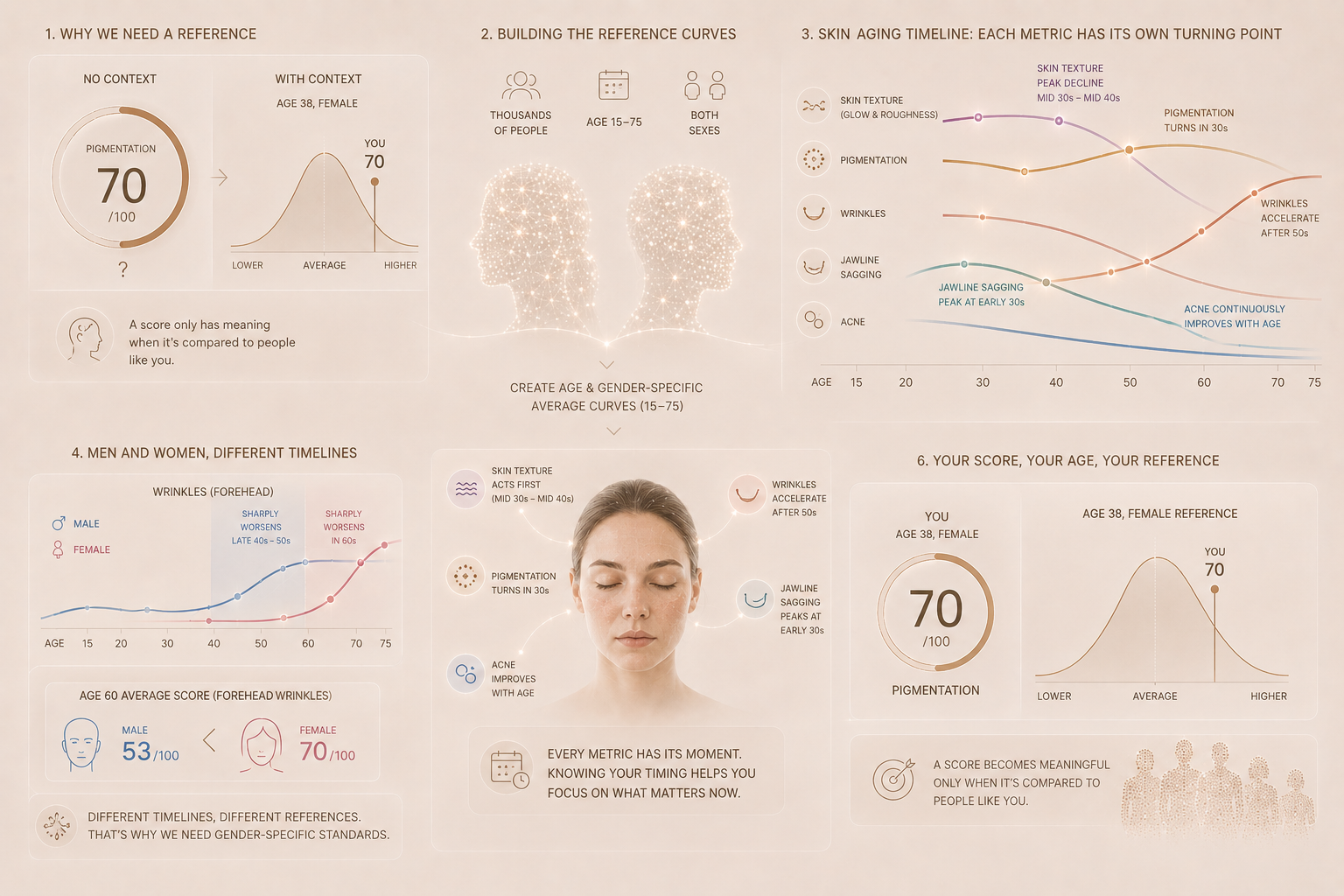
In my first post, writing about the limits of clinic devices, I noted that a screen reading "pigmentation: 70" tells you nothing about what level that actually is. A blood pressure of 120 means something because a normal range exists as a reference. Skin scores had no such reference. Making the score precise (last post) was one problem; having a standard to read it against was another.
A standard requires an average
So we built age- and gender-specific average curves from thousands of people aged 15 to 75 with verified ages. If your pigmentation score is 70, you can now read where that sits against the average for your age and gender.
But as we drew these curves, something beyond a reference standard began to emerge: a timeline of skin aging.
Each indicator turns at a different age
Aging didn't arrive at one speed. Each indicator had its own onset and its own steepest stretch.
- Texture (radiance and roughness) fell fastest between the mid-30s and mid-40s. The feeling that "my skin has changed lately" around that age has a basis
- Pigmentation turned clearly in the 30s, for both men and women
- Wrinkles were the opposite — gentle through the 40s, then accelerating from the 50s. They were also the indicator that changed most over the full range
- The jawline sagging score, unexpectedly, peaked in the early 30s and declined from there
- Acne was the only indicator that actually improved with age
Men and women follow different timelines
Even for the same indicator, the curves moved differently by gender. The clearest case was wrinkles. Men's forehead and eye-area wrinkles worsened steeply from the late 40s through the 50s, while women hit the same acceleration in their 60s. At age 60, the average forehead wrinkle score was 53 for men and 70 for women — a substantial gap.
One can guess at sunscreen or skincare habits, but the data alone can't settle the cause. What is clear is that men and women age on different timelines; which is why the reference itself has to be split by gender.
Knowing the timeline shows you the timing
What this timeline means is simple: in skin care, each indicator has its season. What matters in your mid-30s, when texture changes fastest, is different from what matters in your 50s, when wrinkles begin to accelerate. If you know which of your indicators is entering its turning stretch, you can understand when to consider which procedure. Individual variation is real, of course — specific decisions call for a consultation with a specialist.
This is why INSKINVIEW shows your score alongside your peer average. A score only becomes meaningful against a reference, and that reference has to be the curve for your own age and gender. It's our answer to the question from the very first post: what level is a 70, really?