The Uncertainty of Procedure Decisions
Oncology has standard treatment guidelines. Aesthetic procedures don't. This is about how AI should help with decisions that have no single right answer.
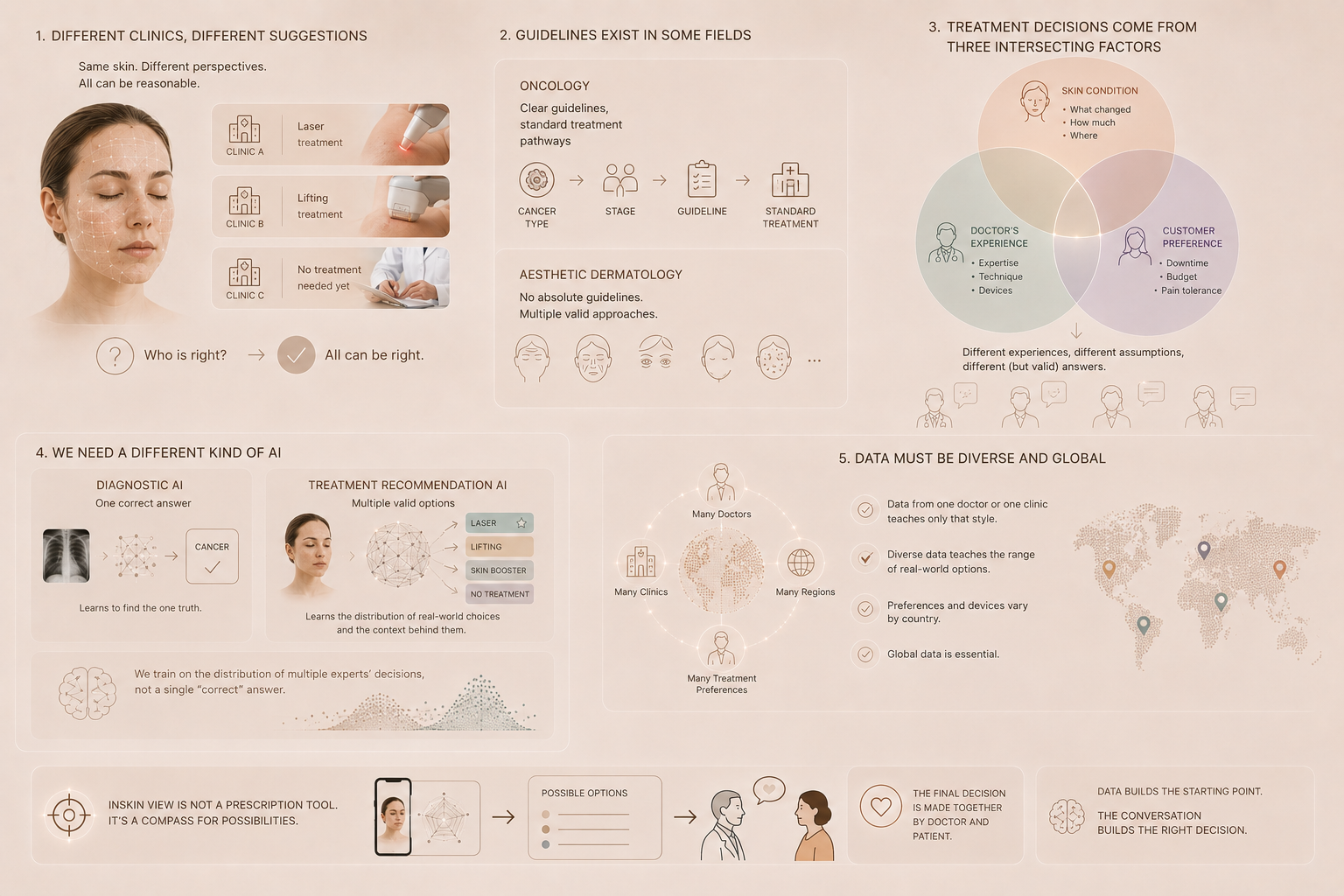
Visit three dermatology clinics with the same concern, and you may come back with three different proposals. One suggests a laser, another a lifting procedure, a third says you don't need anything yet. The experience is confusing: who's right? Today's post is about that question — and the short answer is that quite possibly, none of them is wrong.
Oncology has guidelines
Many areas of medicine run on standard treatment guidelines. Cancer is the clearest example: once the type and stage are set, international guidelines lay out a recommended sequence of care, and physicians worldwide largely operate within that frame. The prognosis research I did at Lunit was possible precisely because such a standardized system exists.
The world of skin procedures has no such absolute guideline. For the same wrinkle, there is no single standard procedure that everyone recommends. This isn't medicine being immature — it's that decisions in this domain are structured differently.
A procedure decision is where three things meet
Skin condition isn't the only input. At least three factors operate together.
- The skin itself: which indicators have changed, by how much, and where
- The physician's experience: which procedures they've mastered, which devices they've worked with
- The patient's preferences: how much downtime they can absorb, their budget, their sensitivity to pain
For the same skin, the best option differs between an office worker who can't afford downtime and someone with time to spare. The same procedure can turn out differently in the hands of a physician who has done it hundreds of times. This is why three clinics give three proposals: each reached a valid answer from different experience and different assumptions.
So a different kind of AI is needed
Here is where this departs from typical medical AI. Diagnostic AI is trained to get the one right answer — "cancer or not" is treated as a problem that has one. But apply that approach to a problem with several valid answers, and the AI ends up presenting one of many reasonable options as if it were the answer. That isn't help; it's distortion.
Earlier in this series I wrote about training on the distribution of expert judgments in severity grading. Procedure decisions are that problem, extended. What the AI needs to learn isn't a single answer, but the range of possibilities actually chosen for a given skin state — and the context behind each.
The data has to widen accordingly
Building this kind of AI starts with different data. Train on one physician or one institution, and the model simply learns that physician's style. The breadth of options only emerges from decisions across many physicians and institutions — and because preferred procedures and devices differ by country, it eventually requires expanding to global data.
That's the direction we're headed. INSKINVIEW, as we see it, shouldn't be a tool that prescribes a procedure — it should be a tool that shows which options exist for your skin. The answer is ultimately decided between a physician and a patient. What data can do is give that conversation a starting point.