Why Before-and-After Comparisons Are Harder Than They Look
When a procedure's effect appears varies by method and by person. This is about what a single before-and-after can't tell you, and how to confirm change cumulatively.

After any procedure, everyone wonders the same thing: did it work? The question sounds simple, but answering it is harder than it looks. In the last post I wrote that there's no single right answer in choosing a procedure — it turns out confirming one is just as tricky. That's today's story.
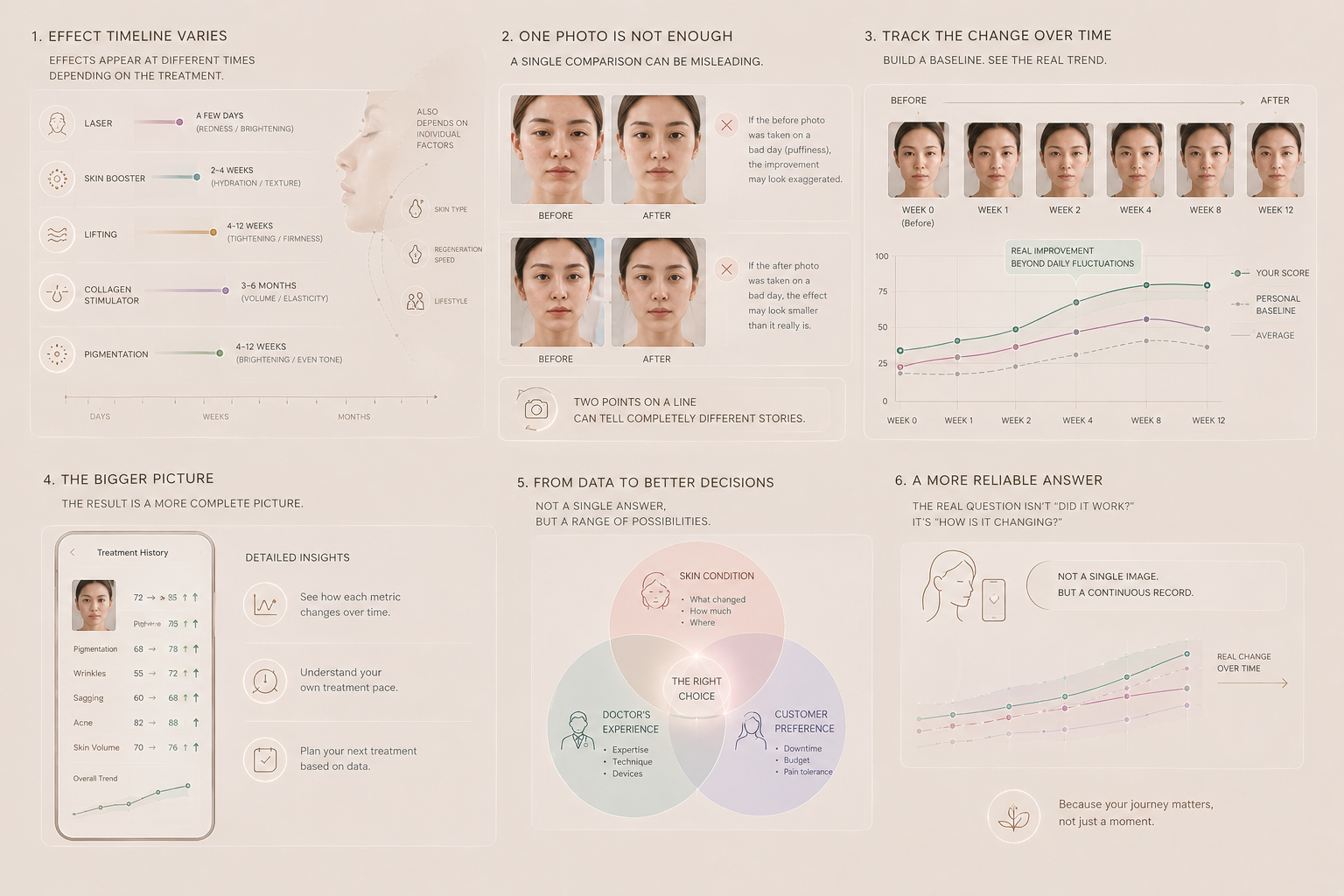
There is no fixed moment when the effect arrives
A procedure's effect isn't complete the moment you leave the clinic. Each method unfolds differently, on a different clock. Some show change within days; others appear gradually over weeks to months. Right after, there's often a stretch where swelling and redness make things look temporarily worse.
Then individual variation stacks on top. For the same procedure, when and how much the effect appears differs by skin barrier, skin thickness, regeneration rate, and lifestyle. In other words, there is no pin-downable moment where you can say "check your results exactly N weeks later."
So a single-point comparison falls short
The common practice is one photo before and one photo a few weeks after. But for the reasons above, that "few weeks after" may land before the effect has fully arrived — or after it has already peaked.
Earlier in this series I wrote that skin fluctuates even within a day. Stack the two problems and it looks like this: if the before photo caught an unusually puffy day and the after photo a good one, the effect looks bigger than it is. Flip the combination, and a perfectly good procedure looks like it did nothing. A line drawn between two points tells a completely different story depending on where those points happened to fall.
Change has to be confirmed cumulatively
The answer isn't picking the right moment. It's not depending on a moment at all.
Measure steadily before the procedure to establish your usual pattern — a baseline. Keep measuring the same way after. Then, even through the daily wobble, you can see whether the trend is pulling away from that baseline: the temporary dip right after, the slow climb, the point where the effect settles in. You confirm the effect not as a single scene but as a process.
There's a side benefit, too. Once you learn the pace at which effects appear on your skin, your sense of when to consider the next procedure starts to rest on data rather than guesswork.
This is why tracking change before and after procedures is a core function of INSKINVIEW. Only when you can measure any time, from a single selfie, can the flow around a procedure be captured without gaps. The most honest answer to "did it work?" comes not from one comparison photo, we believe, but from a record built up steadily over time.