Where on Your Face Does the AI Look?
If an AI scores your wrinkles at 62, what is that score based on? This is how INSKINVIEW checks the basis of its AI's judgments — and how we're working to make scores something you can see.

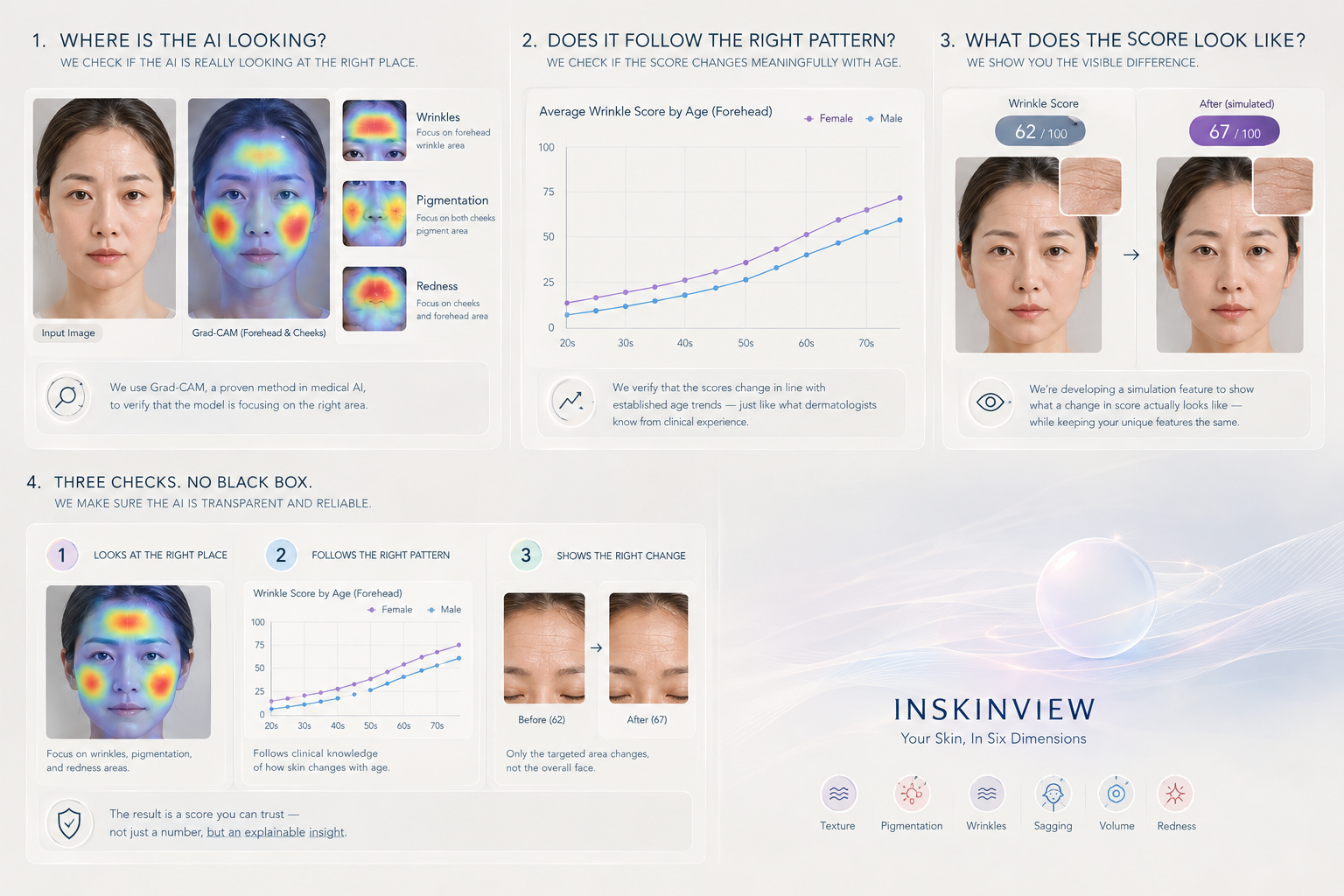
Suppose an AI scores your forehead wrinkles at 62. Can you simply trust that number? If a doctor said the same thing, you could ask: "What did you look at to decide that?" And the doctor would point to the lines on your forehead and explain. AI, though, usually hands over a number without giving a reason. That's why the word "black box" has followed medical AI for so long. Today's post is about how INSKINVIEW looks inside that black box.
Checking that the AI is really looking at the right place
An AI producing a plausible answer while looking at the wrong thing is more common than you'd think. If a model meant to grade forehead wrinkles is actually reacting to bangs or a shadow from the lighting, the number may look reasonable, but the judgment can't be trusted.
So during development, we use methods long established in medical AI, such as Grad-CAM, to check which part of the image the model based its judgment on. It overlays the areas the model focused on as a heat map across the face. For a forehead wrinkle score, the glow should gather over the lines on the forehead; for a pigmentation score, over spots and blemishes. It's a way of confirming, with your own eyes, that the AI is looking where a dermatologist would look.
Checking that scores move properly with age
Even if the model is looking in the right place, whether its numbers move meaningfully is a separate question. So we also check how scores change with age.
In an earlier post, I showed age- and gender-specific average curves. Those curves are a tool for building a reference — and at the same time, a tool for checking the model. If wrinkle scores didn't change with age, the model would very likely be measuring something other than wrinkles. Conversely, when the flow of scores matches the picture of aging dermatologists know from the clinic — wrinkles accelerating after 50, acne improving with age — that's evidence the model is tracking real change in the skin.
If Grad-CAM checks where within a single photo, age-related change checks what is being measured, across the data of many thousands of people.
Making scores something you can see
One problem remains: a number is still just a number. If your wrinkle score goes from 62 to 67, what actually changes on your face? A five-point difference doesn't land intuitively.
That's why we're now developing a skin-change simulation. Based on your own photo, it shows what you would look like if a specific item's score improved by a few points. The principle is clear: only the targeted item should change, and the contours and features of your face should stay exactly as they are. If changing forehead wrinkles also brightened your skin tone or altered your jawline, that wouldn't be a simulation — just a beauty filter.
This work also ties back to the two checks above. When an image with only the forehead wrinkles changed is fed back into the model, only the forehead wrinkle score should move, while every other score stays put. It's a way of confirming, from the opposite direction, that the model is really looking at that item.
A number you can trust is a number you can explain
When you can show where it looks, when it moves with age in ways that make sense, and when you can picture what a difference looks like — only then does a score stop being a number out of a black box and become information you can understand. We've been saying that skin should be seen through data rather than gut feeling. We believe that data, too, has to be able to show its reasons.