Procedures Aren't the Only Thing That Changes Your Skin
Advice on what's "good for your skin" is everywhere, but the weight of the evidence varies wildly. A dermatologist's look at lifestyle and skin, graded by the strength of the evidence.

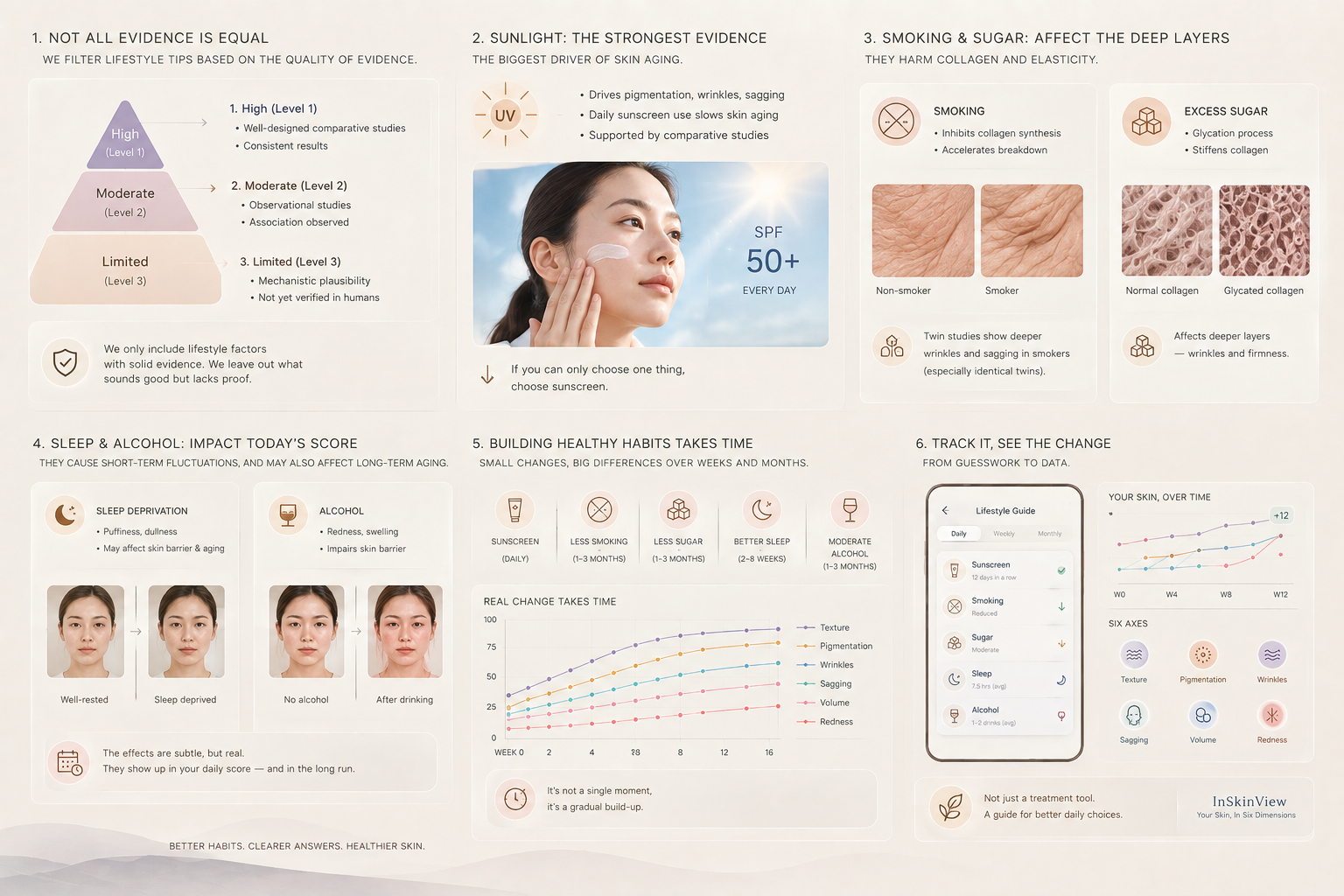
The last several posts have been about procedures. But there's a question I hear in the clinic just as often: "What should I be doing day to day for my skin?" Advice on what's good for your skin is everywhere. The problem is that the evidence behind it varies wildly in weight. Today I want to look at lifestyle and skin through a dermatologist's eyes — graded by the strength of the evidence.
Evidence comes in grades
In medicine, not all evidence is equal. Some things are confirmed by well-designed comparative studies; some show an association in observational research; some are mechanistically plausible but poorly tested in humans. When we built INSKINVIEW's lifestyle guidance, we tried hard to keep this distinction — items with weak evidence were dropped, however plausible they sounded. What follows are the claims that passed that bar.
UV: the strongest evidence
Among lifestyle factors, the one with the largest effect on skin aging is ultraviolet light. A substantial share of skin aging — not just pigmentation, but wrinkles and sagging too — is explained by UV exposure, and there is a comparative trial showing that a group applying sunscreen daily aged more slowly. If you could practice only one habit, the answer is sun protection.
In an earlier data post, I showed that men's wrinkles accelerate at an earlier age than women's. Differences in sunscreen habits become a plausible hypothesis against exactly this background.
Smoking and sugar: they reach the deeper layers
Smoking interferes with collagen synthesis in the dermis and accelerates its breakdown. A well-known study of identical twins found more pronounced wrinkles and sagging on the smoking twin. Excess sugar intake is known to stiffen collagen through a process called glycation. Both touch the deeper layers I wrote about last time — the territory of wrinkles and elasticity.
Sleep and alcohol: they shake today's score
Sleep deprivation and alcohol act less on long-term aging and more on short-term fluctuation: the puffiness and dullness the morning after a bad night, the redness and swelling after drinking. I've written that skin wobbles even within a single day — much of that wobble comes from here. There is also research suggesting chronic poor sleep can affect the skin barrier and signs of aging, so it isn't only a short-term matter.
The effects of habits, too, only show when tracked
Lifestyle differs from procedures in character. A single day's effort is tiny, and the effect accumulates slowly over weeks to months. That's why the mirror can't confirm it — and why people give up quickly.
I've argued that a procedure's effect should be read as a trend, not a single photo. For lifestyle, that logic is even more essential. It's why INSKINVIEW's lifestyle guidance carries only evidence-backed items for each skin state, and is designed so you can track the change that follows across the six axes over time. Looking at skin through data rather than gut feeling applies not only to procedures, but to the choices you make every day.