What a Single Measurement Can't Tell You
Skin changes between days, and even between morning and afternoon. This is about what a single reading can't tell you, and why frequency matters.

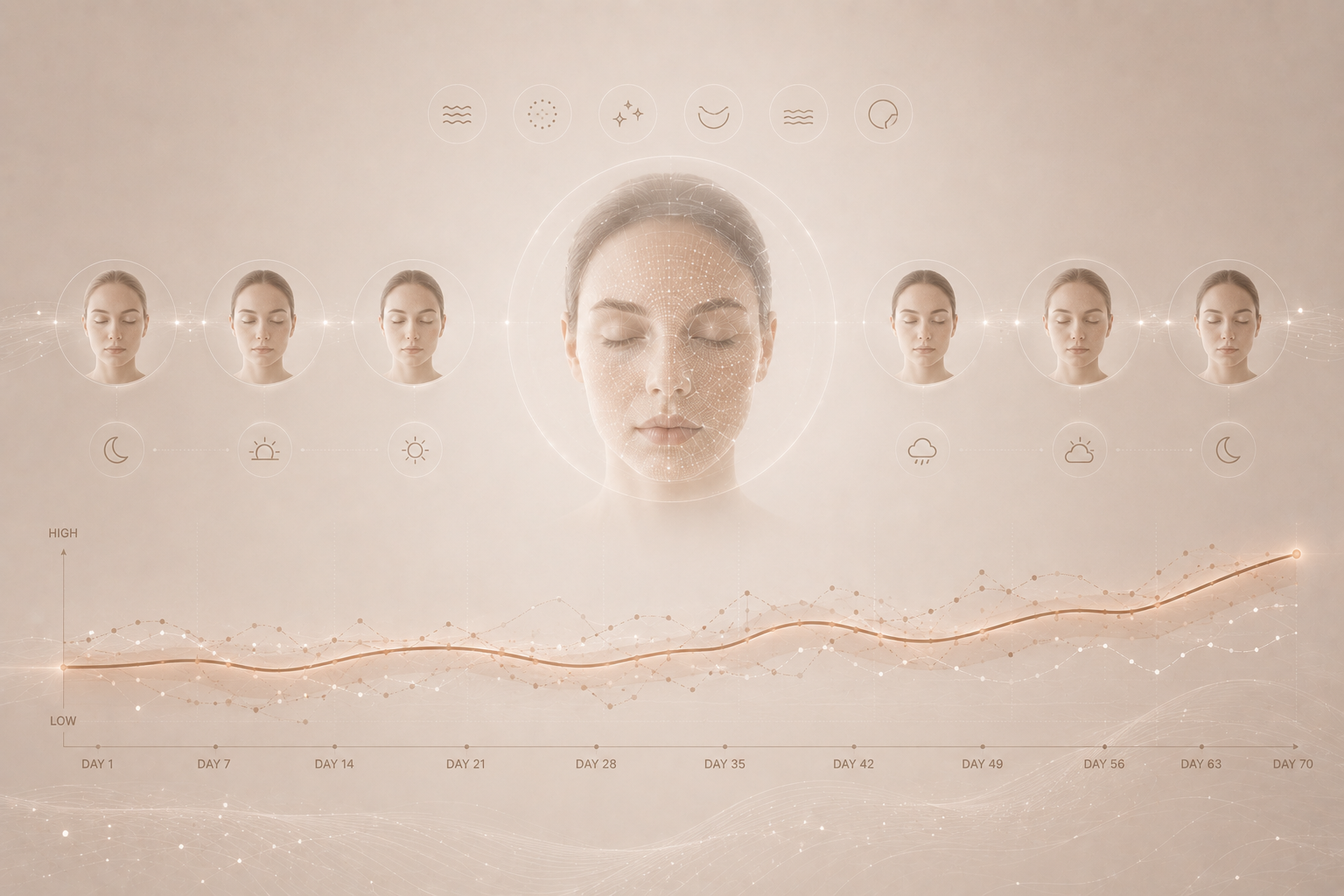
Have a salty dinner and a late night, and your face is puffy the next morning. Everyone knows this, which is why nobody takes their morning face at face value. Yet when it comes to measuring skin, we somehow forget it. We take one photo, one number from one day, and call it "my skin." This post is about why a single reading falls short.
Clinic devices only tell you about that day
In an earlier post I wrote about the limits of clinic equipment: the results stay at the clinic, and the numbers only mean something inside that machine. There's one more to add — you can't measure often.
Once before a procedure, once a few weeks later. That's roughly the cadence in a clinic. What you're left with is two points. You draw a line between them and call it improvement — but the trouble is you don't know how much either point wobbles.
Skin changes more often than you'd think
What you ate the night before, how much you slept, how much water you drank — all of it shows on your face. Season and humidity matter too. And hormonal cycles are well known to move skin condition up and down.
- Puffiness responds sensitively to sleep and diet, especially sodium
- Redness stands out after temperature changes or exercise
- Texture and radiance shift with humidity and season
Skin isn't a fixed state so much as a living indicator that returns a slightly different value every day.
Even wrinkles differ between morning and afternoon
We wanted to see how far this variability actually goes. So we ran a study photographing the same faces in the morning and again in the afternoon, and compared them.
The result was striking. Within a single day, wrinkle measurements shifted subtly. Not something obvious like puffiness, even wrinkles, which we tend to think of as relatively stable, differed between morning and afternoon.
The implication is clear. If when you measure affects the result, it's hard to call any single reading that person's skin.
So: often, and consistently
One measurement is one point. You can't tell whether it landed on a better-than-usual day or a worse one. Measure repeatedly, though, and the points become a line — and only then can you see where your baseline sits and whether anything is actually moving.
The same applies to checking whether a procedure worked. Compare one before and one after, and you're at the mercy of that day's condition. Look across many points, and the direction underneath the noise starts to show.
That's why INSKINVIEW reads skin from a selfie. Being able to measure any time, not only when you visit a clinic, is what lets you find the trend inside all that daily fluctuation. What matters isn't today's score, but the line those scores draw.