Why Skin Analysis Should Happen on a Smartphone
Dermatology clinics have had facial analysis devices for over a decade. This is the story of why it still had to be a smartphone and why now.

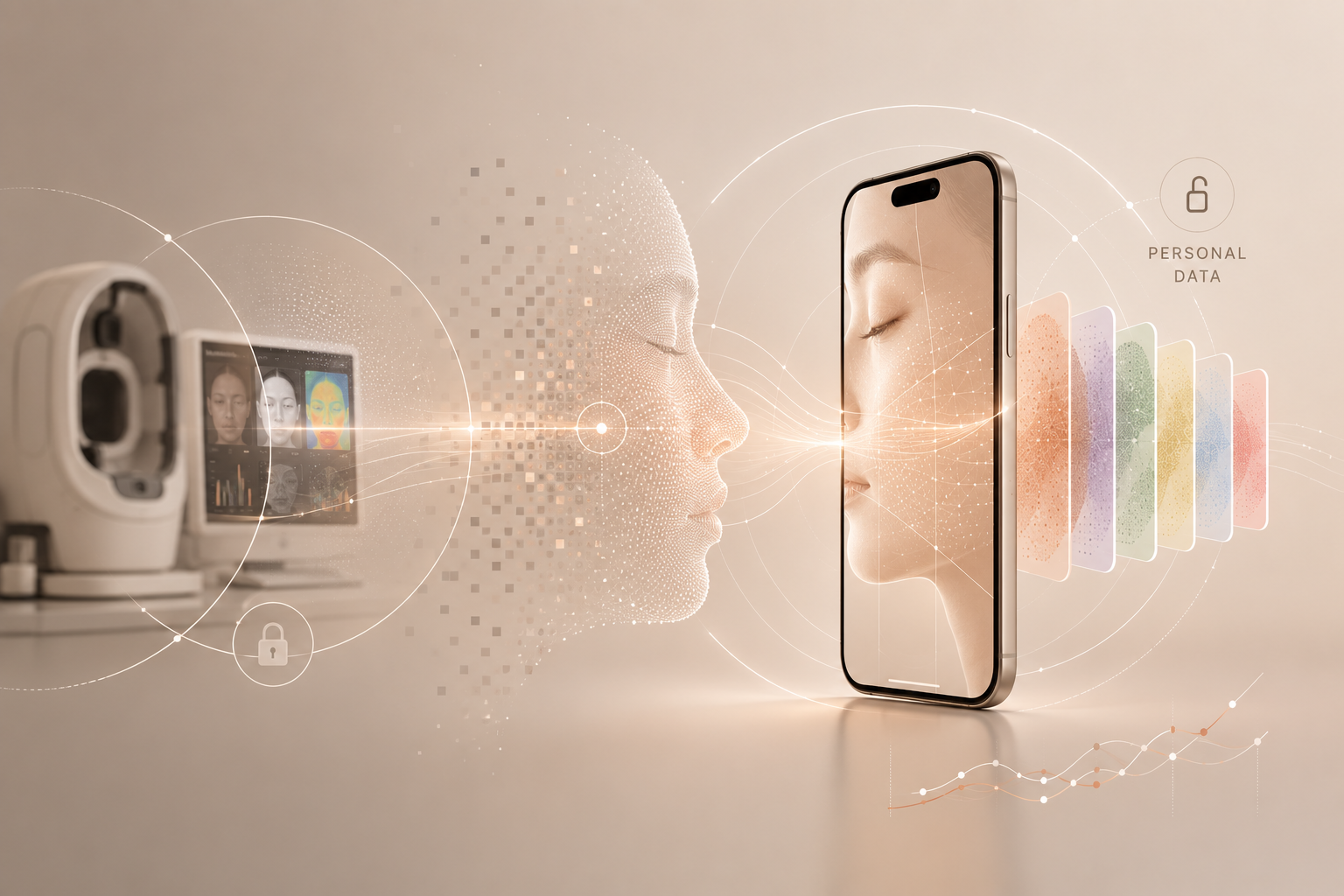
In the two previous posts, I wrote that measuring skin wobbles more than it should, and that even expert judgment doesn't settle into a single answer. That leaves one question: so what do we look at skin with? I chose the smartphone — and to explain why, I have to start with clinic equipment.
Clinic devices have existed for over a decade
Walk into a dermatology clinic and you'll find machines that photograph and analyze your face. These aren't new; they've been in use for more than ten years. But the approach has two limits.
First, the results stay inside the clinic. The photos and numbers from that day sit on the clinic's server, and you can't easily pull them up to manage your own skin.
Second, the values are bound to the device. The screen says "pigmentation: 70," but it's hard to know what level that actually represents. And you can't compare it to a 70 from another company's machine. The incompatible-measurement problem from my earlier post repeats itself here.
Smartphone cameras had already gotten good enough
As a dermatologist, I've long had people send me photos of skin lesions. For the past several years the image quality has been good enough that you can get a reasonable sense of the condition from the photo alone.
In 2020, I led a national data collection project, gathering skin image data with both DSLRs and smartphones. Even then, smartphone image quality was already at a serious level.
Checking your own skin regularly on a smartphone, and choosing what to do about it from there, no longer felt far off.
The problem was the front camera
But to photograph your own face, you need the front camera. That's where I hit the wall.
Around 2020, most smartphone front cameras were under 10 megapixels, markedly lower resolution than the rear ones. On top of that, front cameras distort the face at close range, so you have to shoot from some distance, which shrinks the area the face actually occupies in the frame. The result was low-resolution, noisy images in which fine lines and pigmentation were smeared away.
The reason is simple: front cameras are built to make selfies look flattering, not to capture precise detail.
Using the rear camera solves the image quality, of course. But then someone else has to take the photo. And at that moment you're back to the same problem as the clinic: you can't accumulate data often or consistently.
So I waited
The conditions came down to two. It had to be the front camera, so people could build the record on their own. And the resolution had to become good enough.
Then the iPhone 17's front camera reached 18 megapixels. I judged that this would do, and started InSkin Lab on that judgment.
That's why INSKINVIEW reads your skin across six axes from a single selfie. The record lives in your hand rather than on a clinic server, and yesterday and today are compared on the same scale rather than one machine's private ruler. That's what we were waiting for the technology to make possible.